Local Search in AI: The Verification Loop Explained
Local search in AI works as a verification loop: assistants suggest names, people check them. How to stay consistent and make the shortlist.

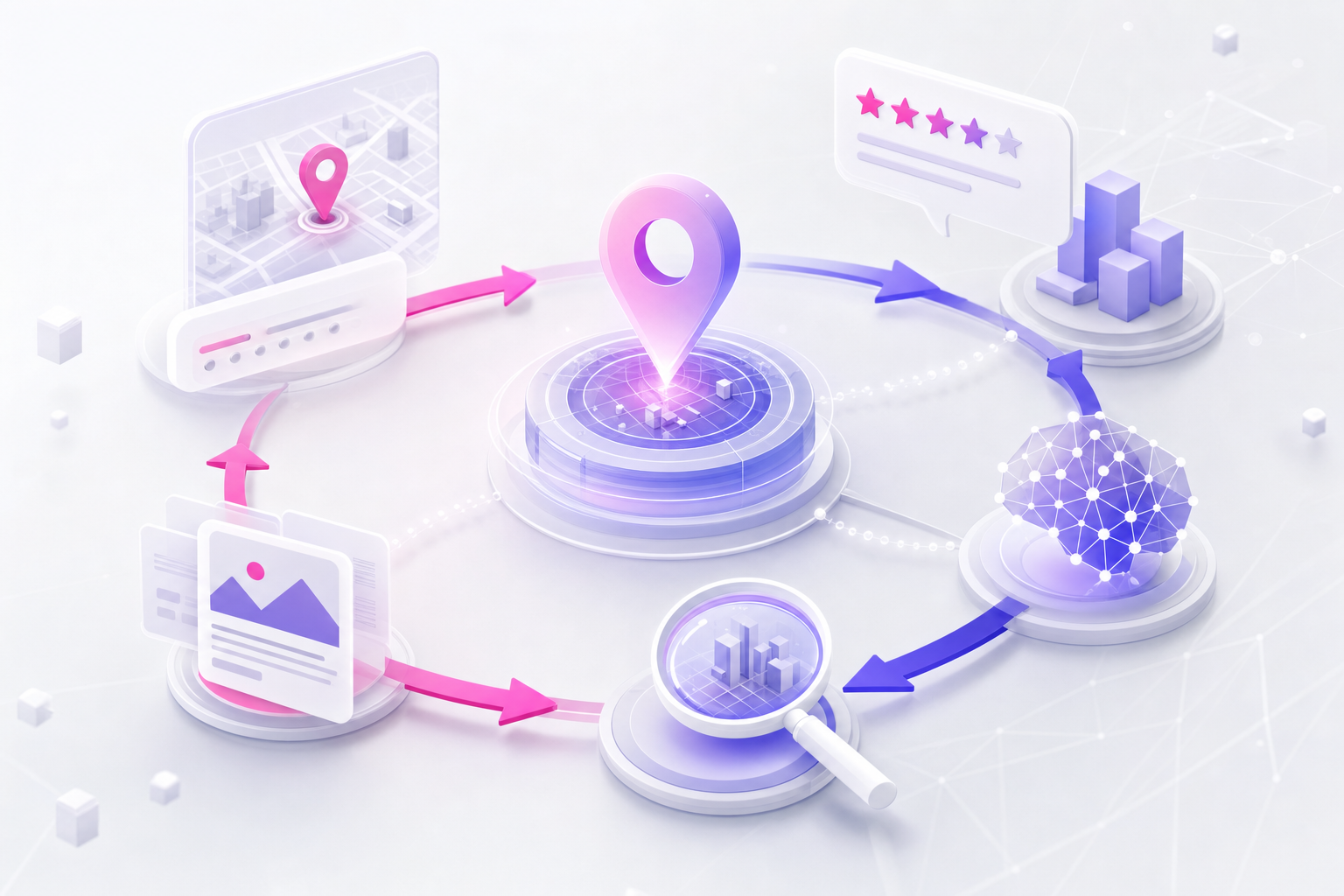
Local search in AI no longer runs as a straight line from query to visit. SOCi reports that 52% of consumers now use AI to find local businesses, up from 9% a year earlier, and each of those searches ends in a short list of names that people then check elsewhere. A business with mismatched details in one channel, or reviews left unanswered, tends to fall out at that verification step.
Key takeaways
- AI starts the decision about a local business, but people finish it in reviews and on social media (the verification loop).
- Businesses AI recommends share accurate details, active reviews, differentiated local content and a consistent multi-channel presence.
- Only a small share of AI citations point to brand-owned sites, so your own website is not enough and distribution matters.
- Measurement has to change: local, based on mentions in answers and branded demand, not last-touch clicks.
What the verification loop looks like in local search
SOCi's data shows people combine channels. 83% discover businesses through a search engine, 55% through social and 52% through AI. Yet 99% read reviews and 43% still verify the business on social media.
Duane Forrester explains in Search Engine Journal why this happens: ten links become three names and a paragraph the brand does not control. Buyers arrive mid-decision, because an assistant does in minutes what used to take weeks. Local businesses feel it first, since the decision is quick and a bad experience is the main risk.
The practical consequence: one inconsistent signal (different opening hours on Yelp, an unanswered complaint) can cancel a conversion the AI itself started.
Four signals both AI and customers check
Semrush summarizes the SOCi Local Visibility Index (350,000 locations, 2,751 brands). Businesses recommended by AI share four things:
- Accurate business details on every platform (Google Maps, Yelp, Facebook, your own site), meaning identical NAP.
- Strong reviews with replies. SOCi finds 72% of consumers prefer businesses that respond to reviews, and 63% have walked away from one that left their question unanswered.
- Differentiated local content instead of generic service copy repeated across every location.
- A consistent presence across multiple channels.
The good news is that this is the same work that improves local pack rankings. A fully completed Google Business Profile (attributes, photos, videos, current information) remains the base, because it is the strongest verifiable legitimacy signal.
Why your own site is not enough: distribution as local SEO
Foundation's research, cited in SEJ, counted 57.2 million citations in AI answers. Only 10.15% pointed to brand-owned domains, and just 2.2% for unbranded queries. The rest goes to review platforms, communities, media and other third parties.
For a local business, that means where you are discussed matters more than where you speak for yourself. The author suggests flipping the time split between creation and distribution from 90/10 to 50/50 and naming someone who owns distribution. Locally, that translates to active profiles, replies in community threads, regional mentions and content worth citing (original data, comparisons, local pricing).
A five-step local visibility audit
1. Map what is being said about you
Ask AI tools 20 to 50 questions your customer would type ("who can fix a boiler today", "best dentist near me"). Record who appears and what is claimed about them. Forrester's first question is the right one: what is said about us, to whom, and how true is it?
2. Align your details
Go through every platform and fix differences in NAP, opening hours and categories. Start with the places AI and people read most often.
3. Build a reply routine
Answer reviews and questions on Google, Yelp and social. Treat it as a conversion element, not reputation housekeeping.
4. Build the roadmap around intent
Corey Morris in SEJ recommends anchoring keywords to a business outcome and checking SERP features for each one. Per Ahrefs, a #1 page loses roughly 58% of clicks when an AI Overview appears. In local research, favor modifiers like "emergency", "same-day" and "open now". Volume is lower, but they sit closer to purchase.
5. Track locally
Monitor rankings at city or ZIP level, not nationally. National numbers distort what happens in your service area.
What to measure when AI sends no clicks
GA4 has an AI Assistant channel and Bing Webmaster Tools has an AI Performance report, but both show only the end of a decision. Also track the share of category answers where you appear, branded demand, and calls and direction requests from your profile. Last-touch attribution loses meaning in local search, and agencies should steer clients toward multi-touch thinking.
If you run these checks across many locations or clients, automate them. The specialists for local visibility and content in Charlie can repeat this audit, and agencies can fold it into regular reporting.
FAQ
How do AI assistants choose which local businesses to recommend?
SOCi's research found four traits shared by businesses AI recommends: accurate details across platforms, strong reviews with active replies, differentiated local content and a consistent multi-channel presence. The same work also helps local pack rankings.
Why do people still check reviews after getting an AI answer?
Trust in AI grows alongside the habit of double-checking elsewhere. SOCi reports that 99% of consumers read reviews and 43% verify a business on social media. AI opens the decision but does not close it.
Do Google rankings still matter for local businesses?
Yes, but a top position is worth less than it used to be. Ahrefs data suggests a #1 page loses about 58% of its clicks when an AI Overview appears. Visibility inside AI answers has to be part of the plan.
How do you measure local visibility if AI sends no clicks?
Track rankings at city or ZIP level, brand mentions in answers to typical category questions, and branded demand and conversions. GA4 and Bing Webmaster Tools only show the tail end of a decision, not the influence on the buyer.
Sources
- Local SEO: What is it & how to do it · Semrush Blog
- How We Build An SEO Content Roadmap For The AI Search Era (Step-By-Step) via @sejournal, @coreydmorris · Search Engine Journal
- AI Changed Your Buyer Faster Than Your Business Can Adapt via @sejournal, @DuaneForrester · Search Engine Journal
- How To Build A Content Distribution System That Compounds · Search Engine Journal
- AI usage surges 6X for local search, fragmenting the digital ecosystem by SOCi · Martech